By Tang Guhan
The Hong Kong Stock market has seen many Chinese unicorns lining up for their Initial Public Offerings (IPOs) recently.
The number of IPO applications at the Hong Kong stock market was around 101, ranking first among others in the first half of 2017, up by 49 percent when compared with the previous year, according to Deloitte, a global professional service company.
Xiaomi issued 2.18 billion shares on June 25 with a per share price of HKD 19.5, which means it plans to raise up to HKD 27.56 billion in total. The company will float at the Hong Kong stock market by July 9. On the same day, Meituan-Dianping, China's largest on-demand service app, unveiled its prospectus for its IPO application in Hong Kong.
Furthermore, companies like live-streaming website Inke.TV, hotel and tickets booking website eLong.com and HaiDiLao Hot Pot, and another 120 companies are on the way. They have applied for IPOs in Hong Kong and are slated to initiate their IPO application process in the second half of the year.
The Hong Kong stock market has raised up to HKD 51.2 billion in the first half of this year, and Enrst & Young, a global professional company, projected there would be around HKD 200 billion during 2018.
After missing out on Alibaba's IPO, the Hong Kong Stock Exchange changed its one-share-one-vote principle to a dual share class, and the new rules took effect on April 30, 2018.
These new rules attracted tech companies to go public in Hong Kong.
Analysts believed that China's newly enforced policies concerning wealth management products had posed challenges for banks to raise funds, which probably led to the crowded IPO applications at present.
Moreover, the giant unicorns have reached a certain scale of valuation and fundraising and they have difficulties in finding appropriate investors in the primary markets.




增发不灭!上半年IPO融资大缩水,增发却达3678亿,是IPO的近4倍

上半年58家企业IPO申请获通过 通过率53.7%
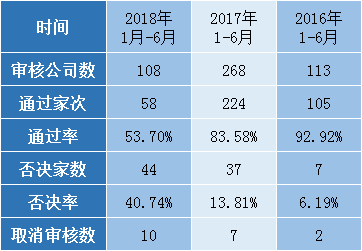
IPO“堰塞湖”水位大降!重质不重量,上半年过会率53.7%!下半场或更趋严
上半年港股IPO火爆 逾百只新股募资512亿港元

上半年香港IPO数量全球第一 独角兽掀上市潮

华兴资本赴港IPO 四成募资用于扩展投行业务
美团点评拟赴港IPO 寻求600亿美元估值

China Mobile, SF Express to be cornerstone investors for Xiaomi’s IPO